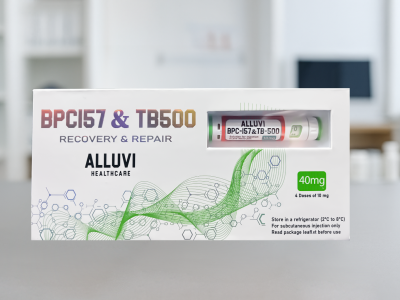
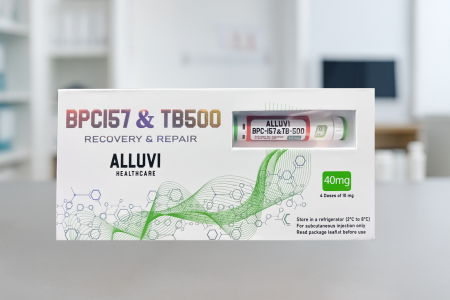
Buy BPC-157 & TB-500 40mg Research Blend | Third-Party Tested, In-Vitro Use Only
Over 100 preclinical studies have examined BPC-157 alone — yet researchers still routinely pair it with TB-500 in comparative tissue-repair models. That combination has become one of the most-referenced dual-peptide pairings in regenerative biology research, and BPC-157 & TB-500 40mg delivers both compounds in a single sealed research device built for laboratory analysis.
If your lab is studying vascular repair, cytoskeletal signaling, or multi-pathway tissue regeneration, here’s what’s in this blend, what the published literature shows, and what to check before you buy.
Two Complementary Repair Pathways in One Device
BPC-157 & TB-500 40mg combines two of the most-studied peptides in tissue-repair research: 20mg BPC-157 and 20mg TB-500 in a single pre-filled research device. The rationale for pairing them isn’t arbitrary — researchers studying multi-mechanism tissue repair have gravitated toward this combination because BPC-157 is thought to primarily drive VEGF-mediated vascularization and mucosal repair, while TB-500 contributes actin-cytoskeletal reorganization and progenitor cell recruitment.
The kit ships sealed and cold-chain shipped for compound stability analysis, formulation studies, and delivery-mechanism evaluation. This blend is intended strictly for in-vitro and preclinical laboratory research — not for human or veterinary use.
Product Specifications
| Attribute | Detail |
|---|---|
| Product | BPC-157 & TB-500 40mg Research Blend |
| Kit contents | 1 × pre-filled research device + research information sheet |
| Total blend contents | 20mg BPC-157 + 20mg TB-500 (40mg total) |
| Form | Sealed liquid, pre-filled research device |
| Intended use | In-vitro / preclinical laboratory research only |
| Storage (unopened) | 2–8°C, refrigerated; do not freeze |
| Regulatory status | Research use only; not evaluated for human or veterinary use |
The Science: Two Distinct, Complementary Mechanisms
BPC-157 — Angiogenic and Vascular Signaling Research
BPC-157 is a synthetic 15-amino-acid pentadecapeptide whose research mechanisms include VEGFR2 upregulation in endothelial cells and tenocytes, driving angiogenic sprouting through PI3K-Akt-eNOS and MAPK-ERK1/2 signaling cascades, along with nitric oxide pathway modulation via eNOS activation. In rat models of quadriceps detachment, BPC-157 accelerated myotendinous and muscle-to-bone junction repair, restoring full muscle function, and enhanced fibroblast migration, osteoblast proliferation, and vascular reorganization. Research on this compound is concentrated in tendon, ligament, and gastrointestinal tissue models.
TB-500 — Actin Regulation and Cell Migration Research
TB-500 is a synthetic analog of Thymosin Beta-4, a naturally occurring peptide studied for its roles in actin sequestration, angiogenesis, and cell migration across preclinical tissue-repair research.Its core research mechanism involves regulating actin polymerization — the process cells use to build internal cytoskeletal scaffolding — which researchers link to enhanced cell migration in systemic wound-repair models, distinguishing it from BPC-157’s more localized effects.
Why Researchers Study Them Together
BPC-157 is understood to increase actin production at the genetic level, while TB-500 organizes that actin into functional structures for cell migration — a mechanistic pairing researchers describe as addressing different phases of the tissue-repair cascade simultaneously.</cite> <cite index=”21-1″>Both peptides exhibit multiphase regenerative synergy in animal models: BPC-157 initiates the repair cascade by stabilizing vasculature and restoring perfusion, while TB-500 follows by amplifying cellular migration and structural remodeling — mirroring the sequence of natural wound recovery.
Why Source BPC-157 & TB-500 From a Verified Research Supplier
| Quality Marker | Why It Matters |
|---|---|
| Disclosed per-compound dosing | Confirms exact BPC-157 and TB-500 content per device rather than an opaque “blend” |
| Third-party purity testing | Verifies identity and concentration of both peptides |
| Sealed, fixed-volume format | Supports consistent, reproducible laboratory measurement |
| Cold-chain shipping | Preserves peptide stability from dispatch to delivery |
| Certificate of Analysis per batch | Traceability for reproducible research findings |
When you buy BPC-157 & TB-500 40mg for laboratory work, look for a supplier that discloses the exact milligram split of each peptide — a combined “40mg” figure without a stated 20mg/20mg breakdown makes it impossible to control for individual compound dose in comparative research.
Storage and Handling for Laboratory Use
| Condition | Requirement |
|---|---|
| Unopened research device | Store 2–8°C, refrigerated; do not freeze |
| Transport | Cold-chain shipment with cold pack strongly recommended |
| Handling | Sealed, fixed-volume format designed for controlled laboratory analysis |
| Disposal | Dispose of used devices and sharps per standard laboratory biohazard protocol |
FAQs About BPC-157 & TB-500 40mg
1. What’s the exact composition of this blend? Each research device contains 20mg BPC-157 and 20mg TB-500, for 40mg of combined peptide content.
2. Why are BPC-157 and TB-500 studied together? Researchers explore the pairing because the two peptides are thought to act on complementary pathways — BPC-157 driving vascularization and TB-500 contributing cytoskeletal reorganization and progenitor cell recruitment.
3. What is BPC-157 researched for specifically? BPC-157 primarily drives localized repair through angiogenesis and nitric oxide signaling, with research concentrated in tendons, ligaments, and gut tissue.
4. What is TB-500 researched for specifically? TB-500 promotes systemic healing by regulating actin polymerization and cell migration, with stronger research signals in muscle, skin, and cardiac tissue.
5. Is this product approved for human use? No. It is supplied strictly for laboratory research and is not evaluated or approved for human or veterinary use.
6. What does preclinical research show about BPC-157’s tissue-repair effects? In rat models of quadriceps detachment, BPC-157 accelerated repair at the muscle-to-bone junction, restored full muscle function, and enhanced fibroblast migration and vascular reorganization.
7. What does research say about the two compounds’ combined mechanism? Research describes a multiphase regenerative synergy — BPC-157 initiates the repair cascade by stabilizing vasculature, while TB-500 follows by amplifying cellular migration and structural remodeling.
8. How should BPC-157 & TB-500 40mg be stored? Keep the sealed research device refrigerated at 2–8°C and never freeze it. Ship and store cold-chain to preserve peptide stability.
9. What should I check before buying a combined BPC-157/TB-500 research product? Confirm the supplier discloses the exact milligram split between BPC-157 and TB-500 (not just total blend weight), provides third-party purity testing, and ships cold-chain with a Certificate of Analysis.
10. Where can I buy BPC-157 & TB-500 40mg for research purposes? Source it from suppliers who disclose individual peptide content per device, publish batch-specific purity testing, and label the product clearly as research-use-only.

Reviews
There are no reviews yet.